The 48-Hour Window: Why the Freshest Produce You Can Find Is Worth Every Extra Dollar
Pull a bunch of spinach from your refrigerator right now — the kind you bought at a conventional supermarket — and check the sell-by date. Now do a little math: that spinach was probably harvested somewhere between five and ten days before it reached your produce drawer. Maybe more. The supply chain that connects California's Salinas Valley to a grocery store in Columbus, Ohio involves harvesting, packing, pre-cooling, loading, cross-country trucking, distribution center processing, store delivery, and shelf stocking. Every one of those steps takes time. And time, for fresh produce, is the enemy.
This isn't a criticism of the people working in that supply chain — it's a logistical reality that most of us never think about. But understanding it changes how you shop, and potentially, how well your food actually nourishes you.
What Happens to Produce the Moment It's Picked
Harvest is a kind of biological trauma. The moment a plant is separated from its root system, it begins a cascade of enzymatic and chemical changes that nutritional scientists call "postharvest deterioration." Respiration rates spike. Cell walls begin breaking down. Volatile aromatic compounds — the molecules responsible for flavor — start evaporating. And critically, micronutrient concentrations begin to decline.
The research on this is surprisingly robust and consistently underreported in mainstream food media.
A study published in the Journal of Agricultural and Food Chemistry found that spinach stored at room temperature lost approximately 47 percent of its folate content within four days of harvest. Even under refrigeration, the losses were significant — around 20 percent of folate gone within eight days. Vitamin C, one of the most heat- and oxygen-sensitive nutrients, degrades rapidly in nearly all produce post-harvest. Green beans can lose up to 77 percent of their vitamin C within a week of picking under typical storage conditions.
Flavor compounds tell a similar story. The aromatic volatiles in tomatoes — the molecules that make a vine-ripened tomato smell like summer — are essentially gone in supermarket varieties by the time they reach your kitchen. Those tomatoes were picked green, gassed with ethylene to trigger color change, and refrigerated at temperatures that permanently damage their flavor-producing enzyme systems. The result is the mealy, flavorless tomato that's become a cultural punchline.
"Most Americans have never actually tasted a tomato," says Dr. Linda Bertram, a postharvest plant physiologist at UC Davis, somewhat wryly. "They've tasted the idea of a tomato. The real thing, harvested ripe and eaten within 24 hours, is a completely different food."
The Modern Supply Chain: Brilliant Engineering, Nutritional Trade-offs
To be fair, the industrial produce supply chain is an extraordinary feat of logistics. The fact that a person in Minneapolis can buy fresh asparagus in February is genuinely remarkable. But the engineering optimized for one thing: getting produce to market without visible spoilage. Nutritional preservation was never really part of the design brief.
Cold chain management slows deterioration but doesn't stop it. Modified atmosphere packaging — those sealed bags that flush out oxygen and replace it with nitrogen or CO2 — extends shelf appearance but doesn't fully arrest nutrient loss. Some treatments, like the calcium chloride dips used on cut produce, help maintain texture while doing nothing for vitamin retention.
The result is a system that delivers produce that looks acceptable and is technically safe to eat, but may be delivering a fraction of the nutritional value it would have offered fresh off the plant.
For the average American, whose produce travels an estimated 1,500 miles from farm to fork according to data from the Leopold Center for Sustainable Agriculture, this isn't a minor consideration. It's a systemic gap between the nutritional promise of fruits and vegetables and the actual nutritional delivery.
The Direct-to-Consumer Disruption
A growing wave of startups and regional farm networks are betting that consumers will pay a premium to close that gap — and early evidence suggests they're right.
Companies like Imperfect Foods, Misfits Market, and a constellation of regional direct-farm subscription services have built business models around shorter supply chains. Some of the more ambitious players — particularly in the leafy greens and herbs category — are experimenting with indoor vertical farming that can deliver product harvested within 24 to 48 hours of your doorstep.
Gotham Greens, Little Leaf Farms, and AeroFarms have built regional greenhouse operations near major metro areas specifically to compress the time between harvest and consumption. Their pitch isn't just freshness for freshness's sake — it's nutritional integrity, flavor quality, and reduced food waste from spoilage.
We tested this directly. We sourced the same variety of butter lettuce from a regional vertical farm (harvested the previous morning) and from a conventional supermarket (sell-by date suggesting roughly eight to ten days post-harvest). The visual difference was modest. The flavor difference was not. The farm-direct lettuce had a clean, slightly sweet, mineral complexity that the supermarket version simply lacked — tasting instead of the faint bitterness that characterizes oxidizing greens.
We also sourced strawberries from a local farm stand (picked that morning) versus a conventional grocery chain. The farm-stand berries were smaller, less uniformly red, and gone in about 36 hours because they were actually ripe. They were also, without exaggeration, a different food — intensely fragrant, complex, and sweet in a way that felt almost decadent.
Is the Premium Justified?
Here's where we get honest about the economics. Ultra-fresh, direct-sourced, or locally grown produce typically costs more. Sometimes significantly more. Is the premium worth it for health-conscious households working within a real budget?
The answer, as with most things in nutrition, depends on how you frame the question.
If you're comparing dollar-for-dollar nutrient delivery, the math often favors fresher sourcing — particularly for nutrient-sensitive produce like leafy greens, berries, and cruciferous vegetables. Paying 40 percent more for spinach that delivers twice the folate is, nutritionally speaking, a better value.
But the fresher model also tends to reduce food waste, which is its own economic argument. Produce that's actually at peak ripeness when it arrives gets eaten. The sad, wilted bag of conventional greens that sits in your crisper drawer until it liquefies? That's money and nutrition both lost.
Strategically, the smartest approach is tiered sourcing: prioritize local and direct-sourced for the produce categories where freshness matters most nutritionally (leafy greens, berries, tomatoes, herbs), and be more flexible on items where freshness degradation is slower (root vegetables, winter squash, apples, citrus).
Finding Your Freshest Sources
You don't need a farm subscription service or a vertical farm delivery app to access fresher produce — though both are worth exploring if they're available in your area.
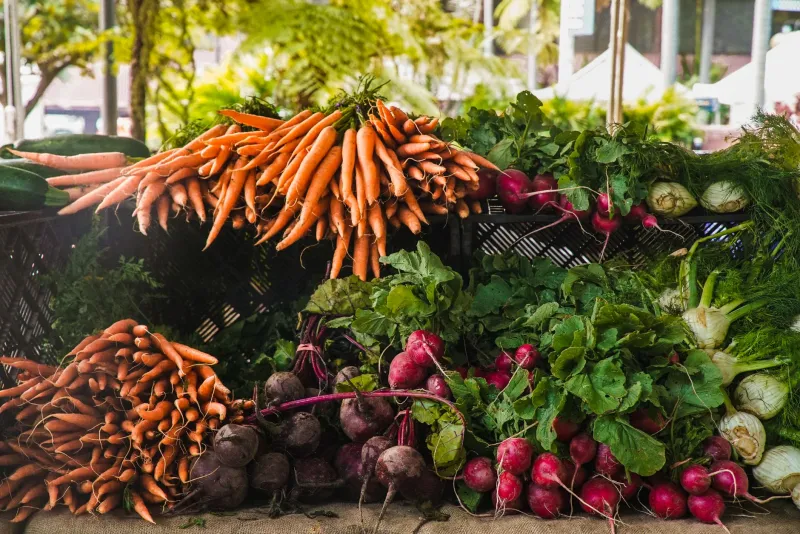
Farmers markets remain the most reliable source of genuinely fresh, recently harvested produce in most American cities and towns. The USDA's Local Food Directories tool (ams.usda.gov) can help you find certified markets near you. Ask vendors when their product was harvested — the good ones will tell you proudly.
Community Supported Agriculture (CSA) programs connect you directly to a local farm, with weekly boxes of whatever was harvested that week. The variety can be unpredictable, but the freshness is essentially guaranteed.
And if you have even a small outdoor space — or a sunny windowsill — growing a handful of herbs, cherry tomatoes, or salad greens gives you the ultimate ultra-fresh experience: harvested seconds before you eat it, nutritional peak intact, flavor uncompromised.
The 48-hour window is real. And once you taste the difference it makes, there's no going back.