Dirt Rich: How Regenerative Farms Are Quietly Changing What Ends Up on Your Plate

There's a moment, if you've ever visited a working regenerative farm, that stops you cold. You reach down and grab a handful of soil — and it's dark, crumbly, almost alive in your palm. It smells like rain and roots and something ancient. Compare that to the pale, compacted dirt on a conventional monocrop operation nearby, and the difference isn't subtle. It's the difference between a living ecosystem and a growing medium that's essentially on life support.
That contrast tells the whole story of why regenerative agriculture has gone from fringe movement to serious conversation in USDA offices, Silicon Valley boardrooms, and, increasingly, your local Whole Foods.
What "Regenerative" Actually Means (And What It Doesn't)
Let's get one thing straight: regenerative agriculture isn't a certified label — at least not yet, not in any universally standardized way. It's more of a philosophy with a toolkit. Practices like cover cropping, rotational grazing, reduced tillage, composting, and integrating livestock with crop systems all fall under the regenerative umbrella. The unifying goal? Building soil organic matter, restoring microbial diversity, and sequestering carbon rather than releasing it.
"We stopped thinking of our fields as dirt and started thinking of them as habitat," says Marcus Tillman, a third-generation corn and soy farmer in central Iowa who began his transition to regenerative practices five years ago. "The first two years were honestly terrifying. Your yields dip, your input costs are still high, and you're kind of flying blind. But by year three, the soil started doing the work for us."
Tillman's experience mirrors what researchers at the Rodale Institute and land-grant universities across the Midwest have been documenting for decades: the transition period is real and financially challenging, but the long-term resilience of regeneratively managed land is measurably stronger — especially during drought years or extreme weather events.
The Carbon Connection Your Grocery Store Isn't Talking About
Here's the part that tends to blow people's minds: healthy soil is one of the most powerful carbon sinks on the planet. When soil is degraded through heavy tillage and synthetic chemical dependence, it releases stored carbon into the atmosphere. Flip that equation — rebuild soil organic matter through regenerative practices — and farmland becomes a net carbon absorber.
A 2022 analysis published in Nature Food estimated that widespread adoption of regenerative practices across US cropland could offset a significant portion of agricultural greenhouse gas emissions annually. That's not a small number. That's the kind of systemic leverage that makes climate scientists genuinely excited.
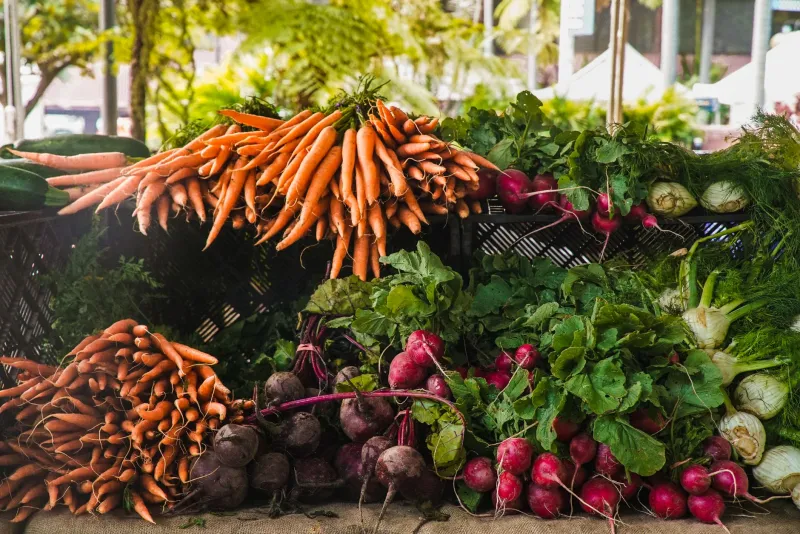
So when you buy a bag of regeneratively grown heirloom carrots at your local farmers market, you're not just getting a better-tasting carrot (though you are absolutely getting a better-tasting carrot). You're participating in a carbon cycle that looks fundamentally different from the industrial alternative.
Finding the Real Deal: How to Spot Regenerative Produce
This is where it gets practical — and a little complicated. Without a single governing certification, how does a conscious consumer actually identify regenerative products?
A few reliable signals to look for:
Third-party certifications with regenerative standards. Organizations like the Regenerative Organic Alliance (ROA) offer the Regenerative Organic Certified (ROC) seal, which layers regenerative soil practices on top of USDA Organic requirements. Brands like Patagonia Provisions, Dr. Bronner's Magic All-One, and a growing number of grain producers carry this seal. It's rigorous, and it means something.
Direct farmer relationships. At farmers markets, CSA programs, and farm stands, you can simply ask. Farmers who practice regenerative methods are almost universally eager to talk about it. Ask about their tillage practices, whether they use cover crops, and how they manage soil health between seasons. The answers will tell you everything.
Specialty retailers with sourcing transparency. Stores like Natural Grocers, co-ops, and regional specialty chains increasingly feature producer profiles and sourcing stories for their produce sections. If a retailer can tell you the farm name and growing philosophy behind their tomatoes, that's a meaningful sign.
"We get customers asking questions now that we never heard five years ago," says Priya Nandakumar, who manages produce sourcing for a regional co-op in Portland, Oregon. "People want to know about soil health, about carbon farming, about whether their food is actually improving the land it came from. That shift in consumer awareness is real."
The Farmer's Perspective: Beautiful Struggle
It would be dishonest to paint regenerative agriculture as a frictionless utopia. The transition is genuinely hard, and the economics don't always pencil out without premium market access or transitional support programs.
In Salinas Valley, California — America's salad bowl — vegetable grower Elena Vásquez has been converting her family's 80-acre operation to regenerative practices over the past three years with support from a USDA Transitional Assistance grant. "The grant helped bridge the income gap during transition, but even with that, there were months where I wondered if we were making a mistake," she admits. "What keeps me going is the soil tests. Every season, the numbers get better. More organic matter, more microbial activity, better water retention. The land is healing, and I can measure it."
Vásquez now sells a portion of her harvest directly to restaurants and through a local CSA, commanding prices that reflect the true cost of growing food responsibly. "When people understand what went into it, they don't balk at the price," she says. "They feel like partners in it."
Your Cart as a Ballot
Consumer demand is, without question, one of the most powerful forces available to accelerate regenerative farming adoption. When farmers can access premium markets for regeneratively grown products, the financial calculus of transition shifts. When retailers stock and promote regenerative lines, awareness spreads. When you choose the ROC-certified grain bowl kit over the conventional option, you're sending a signal that travels all the way back to the field.
This isn't about perfection or guilt. It's about direction. You don't have to overhaul your entire grocery list overnight. Start by finding one farmers market vendor in your area and asking about their soil practices. Add one regenerative-certified pantry staple to your regular rotation. Follow farms on social media that are doing this work and sharing their journey.
The soil beneath our food system is either getting healthier or it isn't. And right now, the direction it moves depends significantly on what enough of us decide to put in our carts.
Fresh choices, made with intention, have always had the power to change what gets grown. This is that moment — and the ground is ready.